I’ve been inside virtual reality casinos where the chips feel real in your hands and the slot machines tower over you like you’re standing on an actual casino floor.
You’re probably curious about how this technology actually works. Or maybe you’re wondering if it’s safe to gamble in a world that feels this real.
Here’s what most people don’t realize: VR casinos run on completely different tech than the online casinos you’re used to. The games work differently. The security works differently. Even the way they protect you from problem gambling is different.
I’m going to walk you through how Glarosoupa VR casinos work from the inside out. Not the marketing version. The real mechanics.
You’ll see how the game engines create those realistic environments. How payment systems keep your money secure when you’re wearing a headset. And most importantly, what safety tools are actually built into these platforms (because that immersive experience can be a double-edged sword).
This isn’t about whether VR gambling is good or bad. It’s about understanding exactly what happens when you step into one of these digital casinos.
By the end, you’ll know how the technology operates and what protections exist to keep the experience fair and safe.
What is a VR Casino? A New Dimension of Online Gaming
You put on a headset and suddenly you’re standing in a casino.
Not clicking through menus on your phone. Actually standing there.
A VR casino is a simulated space you access through a virtual reality headset. You walk through a casino floor that doesn’t exist in the real world but feels like it does. You see slot machines. Poker tables. Other players moving around as avatars.
It’s not like regular online casinos where you tap buttons on a flat screen.
Here’s the difference. Traditional online casinos show you a game interface. You click “spin” or “bet” and watch animations play out. It works, but you’re always aware you’re staring at a website.
VR casinos try to make you forget that entirely.
When you play, you physically walk up to a slot machine (well, your avatar does). You sit down at a poker table. You use hand gestures to place chips. You talk to dealers and other players through voice chat.
Some people say this is just a gimmick. That adding a headset to gambling doesn’t change anything meaningful. They argue the games are the same whether you’re clicking a mouse or waving your hand in the air.
Fair point.
But here’s what they’re missing. The experience isn’t just about the games themselves. It’s about how glarosoupa vr casinos work defstupgamible to recreate that social atmosphere you get in a real casino. The feeling of being somewhere with other people.
That’s harder to dismiss than it sounds.
What you can actually do in a VR casino:
- Walk around a virtual casino floor
- Interact with game objects using hand controllers
- See and hear other players as avatars
- Use voice chat to communicate
- Experience spatial audio and 3D visuals
It’s still early. The technology has limits. But the idea is simple enough.
Take the convenience of online gambling and add back the presence of being there.
The Technology Powering the Virtual Experience
You want to know what actually runs these VR casinos?
I’ll be honest. When I first looked under the hood, I expected smoke and mirrors. Some flashy interface hiding basic slot machine code.
I was wrong.
The tech stack is REAL. And it’s the same stuff powering AAA video games you’ve probably played.
Most VR casinos run on Unity or Unreal Engine. These are the platforms that built Fortnite and Half-Life: Alyx (yeah, the ones with graphics that make your jaw drop). They handle the 3D environments, the physics when you toss chips on a table, the way light reflects off a virtual poker card.
But here’s what matters more than pretty graphics.
The fairness tech.
Every game uses Random Number Generators. You’ve heard of RNGs before. They’re certified algorithms that make sure each card deal or roulette spin is actually random. Not rigged. Not predictable. The same systems that regulated online casinos have used for years.
Some people argue that VR makes this less trustworthy somehow. That the immersion tricks you into thinking it’s more fair than it is.
I think that’s backwards. The RNG doesn’t care if you’re wearing a headset or clicking a mouse. The math is identical. If anything, understanding how glarosoupa vr casinos work defstupgamible helps you see past the visual polish to what actually matters.
Your money moves through SSL/TLS encryption. Same security your bank uses. Same protection when you buy something on Amazon.
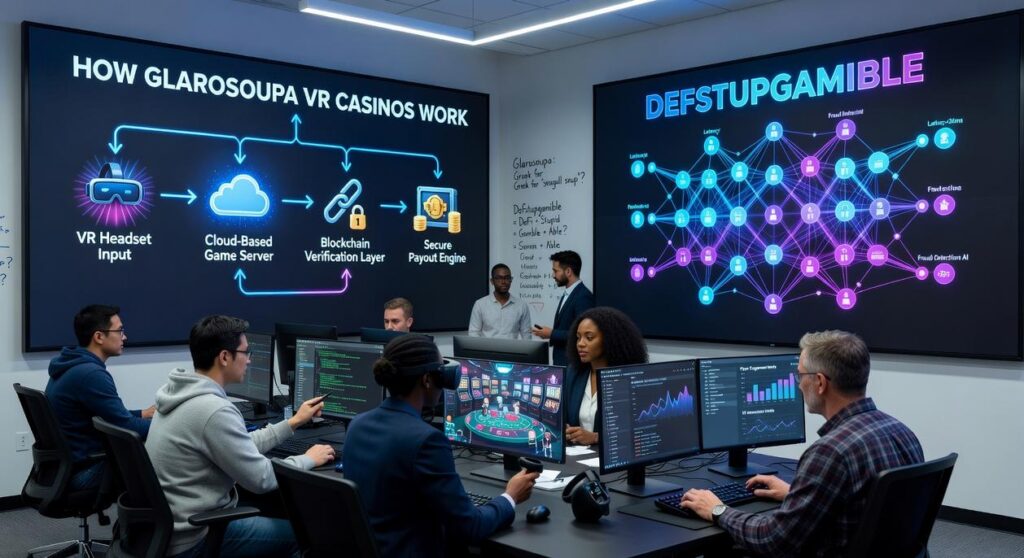
Then there’s the social layer. The part that makes you feel like you’re actually in a casino with other people. That requires serious networking code running in real time. Your avatar’s movements, your voice chat, even your hand gestures when you wave at another player. All synchronized across servers so everyone sees the same thing at the same moment.
Is it perfect? No. I’ve seen lag. I’ve watched avatars glitch through tables.
But the core systems? They work. And they’re built on proven technology that’s been tested in much more demanding environments than a virtual blackjack table.
Ensuring Fair Play and Regulatory Compliance
You want to know if VR casinos are actually legit.
I don’t blame you. Strapping on a headset and betting real money in a virtual space sounds like a scam waiting to happen.
Some people argue that VR gambling is too new to trust. They say regulators haven’t caught up yet and you’re basically playing in the Wild West. Fair point.
But here’s what I’ve found.
The good VR casinos? They follow the same rules as regular online casinos. Sometimes stricter.
Start with licensing. Don’t even consider a VR casino without a proper license. I’m talking Malta Gaming Authority or UK Gambling Commission. These aren’t rubber stamps. They require casinos to prove their games are fair and your money is protected.
No license? Walk away.
Look for independent audits. Companies like eCOGRA test the casino’s software and random number generators. They make sure the odds are what the casino claims. You should see their seal somewhere on the site.
Here’s something most people miss. VR casinos use geolocation tech to block players from restricted areas. If you’re in a state or country where online gambling is illegal, you won’t get through. (Yes, even with a VPN. They’re smarter than that.)
Expect identity verification. Every legitimate platform will ask you to verify who you are. That’s KYC or Know Your Customer. You’ll need to upload an ID and maybe a utility bill.
Annoying? Sure. But it keeps out underage players and stops money laundering.
When you understand how glarosoupa vr casinos work defstupgamible, you realize the security measures aren’t there to hassle you. They’re there because real regulators are watching.
My advice is simple. Check the license first. Then look for audit certifications. If both check out, you’re probably dealing with a legitimate operation.
How VR Casinos Promote Responsible Gambling
The immersion factor in VR casinos cuts both ways.
You put on a headset and suddenly you’re standing in a casino that feels real. The chips feel real. The dealers look real. Everything about it pulls you deeper into the experience.
That’s exactly why platforms know they need stronger safety tools.
Some critics say VR gambling is too immersive to ever be truly safe. They argue that no amount of controls can counteract the psychological pull of a virtual environment that tricks your brain into thinking you’re actually there.
I hear that argument. But here’s what I think they’re missing.
The same technology that makes VR so immersive also gives us tools we’ve never had before. We can literally interrupt the experience in ways that weren’t possible with traditional online gambling.
Let me show you what’s already in place and where I think this is headed.
Player Control Tools That Actually Work
Most VR casinos now include these basic protections:
- Deposit and loss limits that you set before you even enter the virtual space
- Session timers that pop up right in your field of vision (you can’t ignore them like you might on a regular screen)
- Cool-off periods ranging from 24 hours to several weeks
- Self-exclusion options for longer breaks when you need them
The reality check feature is interesting. A notification appears in your virtual environment telling you exactly how long you’ve been playing. You can’t just minimize it or click it away without actually seeing the time.
Here’s where I think we’re going with this.
Within the next few years, I expect VR casinos will start using biometric data from the headsets themselves. Heart rate monitoring could detect when you’re getting too stressed or excited. Eye tracking might identify problem gambling patterns before you even recognize them yourself.
(I know that sounds like science fiction, but the hardware already exists in most modern VR headsets.)
We might see AI systems that learn your playing patterns and gently suggest breaks when your behavior starts matching known risk indicators. Not in an annoying way, but as a natural part of how glarosoupa vr casinos work defstupgamible into their platforms.
The key difference? These interventions happen inside the immersive environment instead of breaking you out of it.
Reputable platforms already provide direct links to problem gambling support organizations right in the virtual lobby. I predict these will become more interactive, possibly offering live counseling sessions in VR itself.
Will this solve problem gambling? No. Nothing ever will completely.
But the tools are getting better, not worse. And that matters more than people think.
The Future of Safe and Immersive Entertainment
You wanted to know if VR casinos are actually safe.
I get it. Strapping on a headset and betting real money feels different than clicking buttons on your phone.
Here’s what you need to understand: VR casinos run on the same certified gaming technology as traditional online platforms. They follow the same strict regulations too.
The immersion is new. The safety standards aren’t.
Every legitimate VR casino includes responsible gambling tools. You get deposit limits, reality checks, and self-exclusion options. These aren’t suggestions. They’re requirements.
How glarosoupa vr casinos work defstupgamible comes down to licensing and player protection. The platforms that skip these steps don’t last long.
You came here worried about safety in an unfamiliar format. Now you know what protects you.
The immersion in VR is unmatched. But player protection still comes first at any legitimate operation.
Stick to licensed platforms. Use the safety tools they provide. Set your limits before you start playing.
VR makes the experience feel real. That’s exactly why the protections matter more than ever.
Choose platforms that take regulation seriously. Your safety depends on it.
 Founder & Chief Creative Director
ryan_b7 is the founder of Glarosoupa.com and the creative mind behind its overall vision and direction. He established the platform as a dedicated hub for gaming culture, esports insight, strategy development, and immersive lore exploration. With a strong passion for game mechanics and player psychology, he focuses on shaping content that not only informs but also elevates how players understand and experience games. ryan_b7 oversees the brand’s identity, long-term growth, and creative execution, ensuring everything aligns with a unified gaming-driven purpose. His leadership blends innovation with structure, turning Glarosoupa into a space where competitive and casual gamers can both grow. He continues to push the platform toward becoming a recognizable name in the gaming and esports knowledge space.
Founder & Chief Creative Director
ryan_b7 is the founder of Glarosoupa.com and the creative mind behind its overall vision and direction. He established the platform as a dedicated hub for gaming culture, esports insight, strategy development, and immersive lore exploration. With a strong passion for game mechanics and player psychology, he focuses on shaping content that not only informs but also elevates how players understand and experience games. ryan_b7 oversees the brand’s identity, long-term growth, and creative execution, ensuring everything aligns with a unified gaming-driven purpose. His leadership blends innovation with structure, turning Glarosoupa into a space where competitive and casual gamers can both grow. He continues to push the platform toward becoming a recognizable name in the gaming and esports knowledge space.